
By Alex Oh
Artificial intelligence is no longer the stuff of science fiction. These days, it seems we come across it everywhere: in the news, at our jobs, and on our social media feeds. Alongside thinking about our own experiences with AI, we should pay attention to how the younger generation is growing up with the technology—and specifically how students are learning to use it in the classroom.
Schools across the D.C., Maryland, and Virginia area have already begun introducing AI and other STEM topics into the curriculum earlier than many parents might expect.
Starting with curiosity
At Vienna Elementary School in Fairfax County, one corner of the library has become the Vienna.i.Lab. All students, kindergarten through sixth grade, visit the lab to learn how AI and generative AI fundamentally operate and how to use the technologies ethically and responsibly.
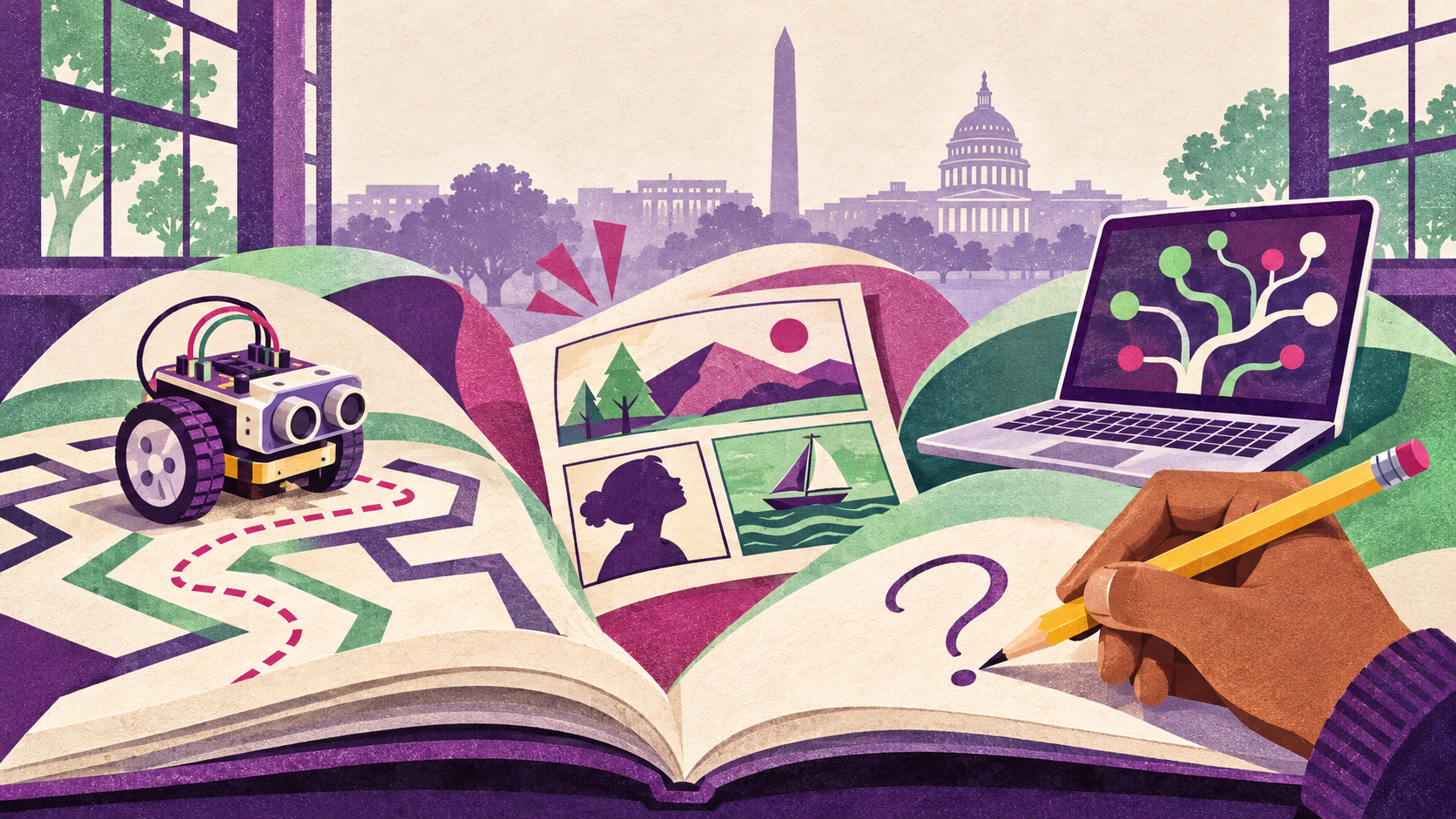
In one lesson, sixth graders linked blocks of code to program tiny Ozobot robots, then worked in pairs to guide them through a wooden maze by trial and error.
The school’s technology specialist, Dave Reynolds Jr., explained that the point is to build the mental foundation for understanding AI. He tells students that AI works by predicting the most likely next word from patterns in its data, rather than truly knowing things. The concern driving the lab is practical: students use these tools outside school, and he doesn’t want them treating AI like a simple Google search.
Expanding access in middle school
Middle school is where many districts are expanding students’ exposure. As of late 2025 in Prince George’s County, all middle and high schools had access to at least one AI program, ranging from Google’s Gemini to curriculum-specific tools, as part of a pilot of eight platforms.
The district describes this as an equity effort, noting that more than 90% of its students are Black or Latino, groups historically underrepresented in the technology sector.
Robotics clubs are another entry point. A $520,000 grant from Google to Virginia middle schools, announced in 2023, aimed to expand robotics and AI education programs and led to the creation of a new club at Herndon Middle School in Fairfax County.
Learning to create—and question
Washington Leadership Academy, a D.C. charter school, may offer the clearest picture of what’s possible.
About 100 students spent a morning at a school hackathon building their own AI-powered chatbots, including one to help classmates share concerns with school leaders.
At WLA, AI education is also built directly into classroom lessons. In Giani Clarkson’s AP Government class, students designed a fictional country’s resources to survive a simulated war against their teacher’s invented nation, then had to work out for themselves why they won or lost.
A math coach built a practice chatbot that encouraged students to push back when the AI model returned wrong answers. The school also takes a thoughtful approach to the cheating question, using a rubric from zero—no AI—to four—unlimited AI—to set expectations for each assignment.
Elsewhere in the DMV, high school students are learning AI as both a subject and a creative aid.
Thomas Jefferson High School for Science and Technology in Fairfax offers an AI elective for students who have completed AP Computer Science. Students learn to write their own algorithms rather than rely on ChatGPT.
In Prince George’s County, journalism and graphic arts students use a platform called Lumi Story AI, which helps them write and illustrate graphic novels and gives feedback on their writing.
At Montgomery Blair High School in Silver Spring, teacher Nora Burkhauser said demand for her AI course was strong enough that she doubled her sections in a year.
In August 2025, the superintendent of Prince William County said the district planned to launch Microsoft Copilot for high school students so they could learn to use it responsibly.
Setting boundaries for responsible use
Policy is still catching up with practice.
In Maryland, the Artificial Intelligence Ready Schools Act gave districts 120 days after the state issued its guidance to set their own AI policies. That guidance includes eight elements for schools to consider, including data privacy, technology bias, and keeping instruction human-centered.
Virginia districts are moving in a similar direction. Arlington Public Schools is working on a new academic integrity policy addressing AI and other emerging technologies.
Fairfax County Public Schools has taken a more restrictive approach for its youngest students, prohibiting elementary students’ use of generative AI during instructional time.
Across districts, the common thread is that AI supports the teacher rather than replacing them. As one Maryland education official explained, the teacher remains the subject-matter expert in the classroom.
In September 2026, D.C.’s Office of the State Superintendent of Education released its AI Model Policy for Staff Use.
The policy is intended to support local education agencies as they consider how best to incorporate AI throughout the 2026–27 school year. Developed in response to feedback from education leaders, it adopts a “stoplight” framework: identifying uses that are prohibited, uses requiring enhanced oversight, and uses allowed with professional awareness and human review.
The model policy addresses staff use rather than student use and can be tailored to individual education agencies throughout the District of Columbia.
Supporting the educators behind the tools
Teachers are receiving new tools, many of them free or externally funded.
Fairfax and Prince William counties were part of the first national group of districts to try ChatGPT for Teachers, which is free to educators through June 2027. Arlington Public Schools gave educators access to Copilot, Gemini, NotebookLM, and SchoolAI, along with training courses on responsible use.
Outside funding also plays a role. Vienna Elementary’s lab began with a donation from the school’s PTA and a grant from the Northwest Federal Credit Union Foundation.
Training to use these tools, however, remains a challenge. Maryland’s guidelines require professional development opportunities so educators can learn to use AI responsibly in the classroom. But the state provides general online modules, leaving districts to train teachers on the specific tools they choose. One superintendents’ association leader noted that fitting that training into an already limited schedule could be tough.
Making opportunity available to every student
The successful integration of AI in the classroom will depend on a combination of factors.
Students should learn to understand and use AI responsibly, both to meet their learning objectives and to spark creativity as they think about their long-term goals.
Teachers should consider implementing classroom policies that facilitate responsible use. School districts should invest in equipping educators with the tools and training needed to deepen both their own understanding of AI and that of their students.
The examples across the DMV show what’s possible when schools take that approach. They also raise an important question for our communities:
Can every student, in every school, have the same chance to learn how this technology works?